


AI content writing for SEO small business owners has transformed from a risky experiment into a necessary competitive advantage. In 2026, the question isn’t whether you should use AI for content creation—it’s how to use it correctly without getting penalized by Google or losing your brand’s unique voice. The difference between businesses that succeed with AI content writing for SEO small business strategies and those that fail comes down to following proven workflows and avoiding critical mistakes.
This guide shares seven proven tips for AI content writing for SEO small business owners, based on what’s actually working in 2026. We’ll cover Google’s current stance on AI-generated content, the exact workflow that produces ranking content, which tools to use, and the common mistakes that can destroy your credibility. If you’re looking for the right AI tools to support your content strategy, our guide to the best AI SEO tools for small businesses covers the top options for every budget.
Table of Contents
- Google’s Current Stance on AI Content Writing
- The Right Way: AI-Assisted Content Workflow for Small Business
- The Wrong Way: What to Avoid at All Costs
- Best AI Content Writing Tools for Small Business SEO
- How to Maintain Your Brand Voice With AI
- Content Types AI Handles Well vs. Needs Human Input
- Common AI Content Writing Mistakes Small Businesses Make
- Workflow Template: From Keyword to Published Content
- Final Verdict: AI Content Writing for SEO Small Business Success
Google’s Current Stance on AI Content Writing
Before diving into tactics, let’s address the biggest concern small business owners have about AI content writing for SEO: will Google penalize me? The short answer is no—but with an important condition. Google has explicitly stated that it does not penalize AI-generated content as long as it’s helpful, accurate, and created for people rather than to manipulate search rankings.
According to Google’s official guidance on AI-generated content, the search engine evaluates content quality regardless of how it was produced. Whether written by a human, an AI, or a combination of both, Google cares about E-E-A-T: Experience, Expertise, Authoritativeness, and Trustworthiness. This is a crucial insight for AI content writing for SEO small business strategies—you can use AI extensively as long as the final output demonstrates real expertise and provides genuine value to readers.
However, Google’s algorithms have become increasingly sophisticated at detecting low-quality, mass-produced AI content. Content that is factually incorrect, lacks original insight, or reads like a robot wrote it will not rank well, regardless of whether Google explicitly penalizes AI content. This is why the hybrid approach we recommend throughout this guide is essential. For a deeper understanding of how AI fits into your overall strategy, our AI SEO vs manual SEO comparison explains where AI excels and where human judgment remains irreplaceable.
The Right Way: AI-Assisted Content Workflow for Small Business
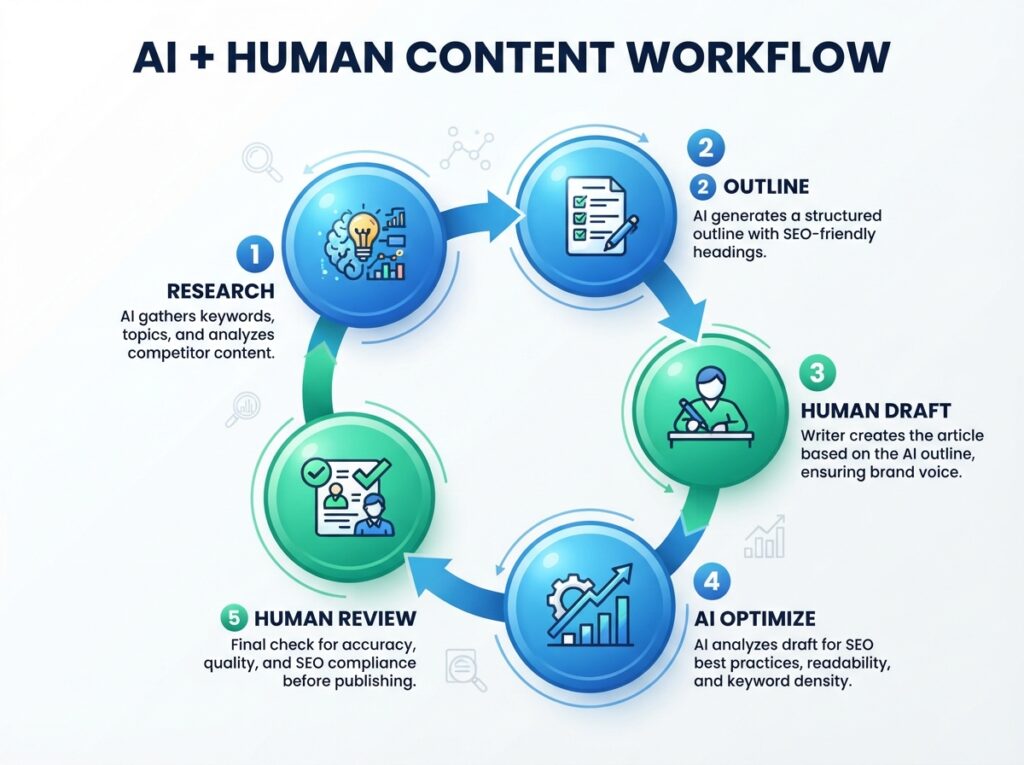
The most successful small businesses using AI content writing for SEO follow a five-stage workflow that combines AI efficiency with human expertise. This isn’t about letting AI write everything and hitting publish—it’s about using AI strategically at each stage while maintaining human oversight where it matters most.
Stage 1: AI-Powered Research (15-30 minutes)
Use AI SEO tools like Frase or Surfer SEO to analyze the top 20-50 ranking pages for your target keyword. The AI identifies exactly which topics, headings, questions, and semantic terms top-performing content includes. This transforms content research from guesswork into data-driven strategy. Instead of wondering what to include, you get a detailed brief showing exactly what Google expects to see in comprehensive content on your topic. Our AI SEO tools comparison helps you choose the right research tool for your budget.
Stage 2: AI-Generated Outline (5-10 minutes)
Based on the competitive research, AI tools generate a content outline with suggested H2 and H3 headings, word count targets per section, and key topics to cover. This outline ensures your content structure matches what’s already working in the search results. Review the outline and adjust it based on your unique expertise—add sections that competitors missed, remove sections that don’t apply to your business, and reorder headings to tell your story.
Stage 3: Human Drafting With AI Assistance (2-4 hours)
This is the most important stage. Write the content yourself or with a human writer, using the AI-generated outline and research data as your guide. AI writing assistants can help draft individual paragraphs or suggest phrasings, but the core content—the insights, examples, stories, and expertise—must come from you. Your real-world experience with customers, your unique understanding of your industry, and your personal perspective are what make content valuable and ranking-worthy. AI can’t replicate your actual experience running a small business.
Stage 4: AI-Powered Optimization (20-30 minutes)
Once your draft is complete, run it through an AI content optimization tool like Surfer SEO or Frase. The AI scores your content against top-ranking competitors and identifies gaps: missing topics, underutilized keywords, sections that need more depth, and opportunities to add relevant questions and answers. Use these suggestions to strengthen your content, but don’t blindly chase a perfect score. Content that reads naturally at 80/100 will outperform keyword-stuffed content at 95/100 every time.
Stage 5: Human Review and Fact-Checking (30-60 minutes)
Before publishing, a knowledgeable human must review every piece of content for accuracy, brand voice, and genuine helpfulness. Check all facts, statistics, and claims against primary sources. Verify that any AI-generated statements are correct. Ensure the content sounds like your business, not like a generic AI. This final review is non-negotiable—it’s your quality control checkpoint that prevents embarrassing errors and maintains your credibility.
Time saved with this workflow: Small businesses following this AI-assisted process typically cut total content creation time by 40-50% compared to fully manual writing, while producing content that’s more thoroughly researched and better optimized than either pure AI or pure human approaches could achieve alone.
The Wrong Way: What to Avoid at All Costs
Warning: The fastest way to damage your site’s reputation and rankings with AI content writing for SEO small business is to generate content and publish it without human review. This approach will eventually catch up with you.
Here’s what the wrong approach looks like: you ask ChatGPT or another AI tool to “write a blog post about X,” copy the output, and publish it directly to your website without any meaningful changes. This approach fails for multiple reasons. AI-generated content without human input is typically generic, lacks original examples, contains no real-world experience, and often includes factual errors or outdated information. Google’s algorithms are increasingly capable of identifying content that provides no unique value, and users can immediately tell when content was written by a robot.
The wrong approach also includes using AI to mass-produce hundreds of thin, low-quality pages targeting keyword variations. This tactic—often called “content spraying”—was briefly effective years ago but now triggers Google’s spam detection systems and can result in manual actions against your entire site. AI content writing for SEO small business strategies must prioritize quality over quantity.
For a complete guide to avoiding these and other SEO pitfalls, see our guide to common SEO mistakes small businesses make.
Best AI Content Writing Tools for Small Business SEO
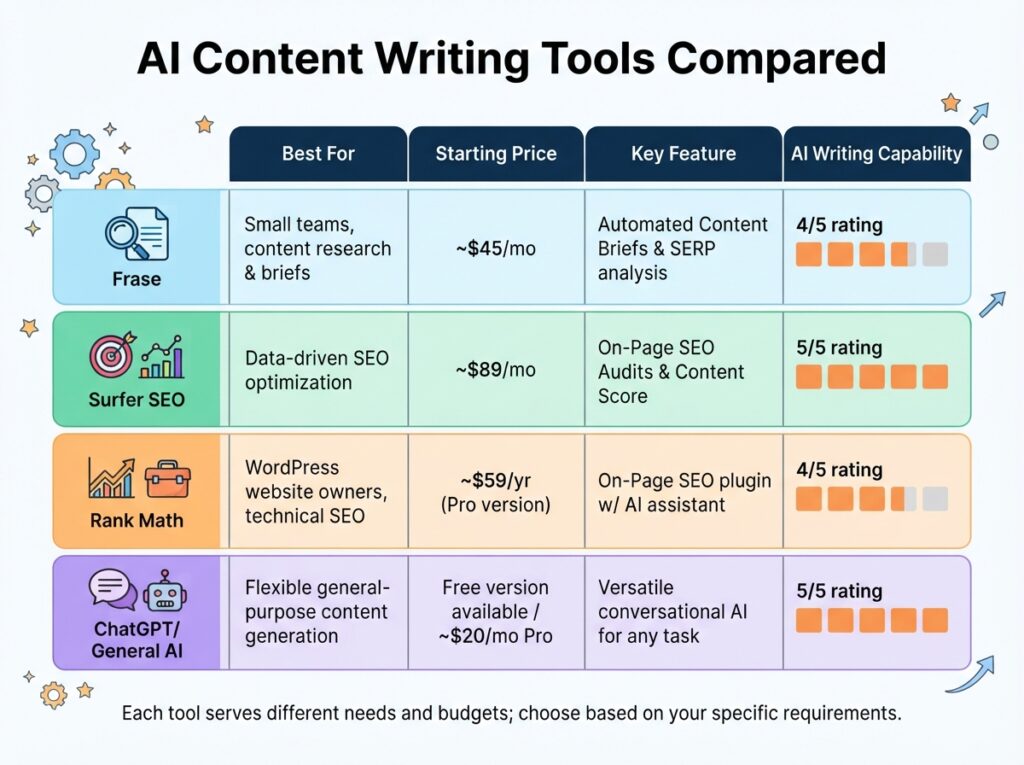
Choosing the right AI content writing tools is critical for your AI content writing for SEO small business strategy. Here are the top options for small businesses in 2026, organized by use case:
Best for Content Optimization: Frase ($14.99/mo)
Frase is the best budget option for AI content writing for SEO small business owners. It analyzes the top 20 search results for your keyword and provides a content brief with recommended topics, headings, and questions to include. The content editor scores your writing in real-time against competitors, showing you exactly which topics you’ve covered and which you’ve missed. At $14.99/month for the Solo plan, it’s the most affordable way to get professional content optimization. For a complete review, see our AI SEO tools comparison guide.
Best for Content Teams: Surfer SEO ($89/mo)
Surfer SEO offers the deepest content analysis, evaluating the top 50 ranking pages and scoring your content against 500+ on-page signals. The AI outline builder creates detailed content structures, and the NLP entity analysis catches semantic gaps that other tools miss. It’s ideal for businesses publishing 8+ articles per month who need competitive-grade optimization.
Best for WordPress Users: Rank Math PRO ($6.99/mo)
Rank Math brings AI content suggestions directly into the WordPress editor. Its Content AI module analyzes your target keyword and suggests improvements in real-time as you write. At $6.99/month, it’s the most affordable AI content writing tool available, though its analysis depth is less sophisticated than standalone tools like Frase or Surfer SEO.
General AI Tools (Supplementary Only)
ChatGPT, Claude, and similar AI assistants can help with brainstorming, drafting individual paragraphs, and rephrasing sentences. However, they lack the SEO-specific capabilities—SERP analysis, content scoring, keyword optimization—that dedicated AI content writing tools provide. Use them as supplements, not replacements. For more guidance on choosing tools, our small business SEO guide explains how content fits into your broader strategy.
How to Maintain Your Brand Voice With AI
One of the biggest challenges in AI content writing for SEO small business owners is maintaining a consistent, authentic brand voice. AI tools default to a generic, neutral tone that sounds like everyone else—and sounding like everyone else is the opposite of effective content marketing.
Create a Brand Voice Guide
Before using AI for content creation, document your brand voice. Define your tone (professional, friendly, authoritative, conversational), your vocabulary (words you use and avoid), your sentence style (short and punchy or detailed and thorough), and your unique perspective (what makes your business different). Give this guide to any human writers you work with, and use it to evaluate AI-generated content.
Use AI for Structure, Not Voice
Let AI tools handle the structural elements: topic coverage, heading hierarchy, keyword placement, and competitive gaps. You handle the voice: the stories, examples, opinions, and personality that make your content distinctively yours. When you draft content yourself and use AI only for optimization suggestions, your brand voice naturally comes through.
Edit AI Content Aggressively
If you use AI to generate draft paragraphs, edit them heavily. Add your own examples. Replace generic statements with specific stories from your business. Inject your personality into every section. A good rule of thumb: if a paragraph could have been written by any business in your industry, it needs revision.
Content Types AI Handles Well vs. Needs Human Input
Not all content benefits equally from AI assistance. Understanding which content types work well with AI content writing for SEO small business strategies—and which require heavier human involvement—helps you allocate your time effectively.
Content Types AI Handles Well (With Human Review)
- Product descriptions: AI excels at creating unique, detailed product descriptions at scale, especially for e-commerce businesses with large catalogs. Provide the product specifications and let AI draft descriptions that you then customize.
- FAQ pages: AI can analyze “People Also Ask” data and competitor FAQs to identify questions your customers are asking, then draft clear, concise answers. This is one of the highest-ROI uses of AI content writing for SEO small business websites.
- How-to guides and tutorials: For straightforward instructional content, AI can organize steps logically and ensure completeness. Add your own tips, warnings, and real-world insights to elevate the content.
- Listicles and roundups: Structured comparison content like “Top 10 X for Y” benefits from AI’s ability to gather and organize information systematically.
- Service area pages: For local businesses with multiple locations, AI can help create unique, optimized pages for each service area while maintaining consistency. See our local SEO guide for location-specific strategies.
Content Types That Need Heavy Human Input
- Thought leadership and opinion pieces: Content that establishes your expertise and unique perspective cannot be AI-generated. These pieces must come from your actual experience and insights.
- Case studies and customer stories: Real results, specific numbers, and genuine customer experiences require human collection and storytelling. AI can help structure the format but cannot create authentic case studies.
- YMYL content (health, finance, legal): Content that could impact someone’s health, finances, or legal situation must be written or thoroughly reviewed by qualified professionals. AI-generated claims in these areas can create serious liability. Our SEO mistakes guide covers YMYL considerations in detail.
- Company about pages and brand stories: Your origin story, mission, and values must be authentically yours. AI can suggest structure but the content must be original.
Common AI Content Writing Mistakes Small Businesses Make
Learning from others’ errors is cheaper than making your own. Here are the most common mistakes in AI content writing for SEO small business strategies:
Mistake 1: Publishing without human review. This is the cardinal sin. AI-generated content always needs a human check for accuracy, brand voice, and genuine value. Publishing unreviewed AI content is like sending an unedited draft to a client—it damages your credibility.
Mistake 2: Chasing perfect content scores. AI optimization tools give your content a score based on competitor analysis. Obsessing over reaching 100 can lead to unnatural, keyword-stuffed writing. Aim for 70-80 and prioritize readability and helpfulness over perfection.
Mistake 3: Ignoring E-E-A-T signals. Google wants content that demonstrates Experience, Expertise, Authoritativeness, and Trustworthiness. AI cannot provide these—only you can. Include author bios, cite credible sources, share real examples, and demonstrate your qualifications throughout your content.
Mistake 4: Using AI to replace strategy. AI tools tell you what to write about based on what’s already ranking. They don’t tell you whether those topics align with your business goals, attract your ideal customers, or differentiate you from competitors. Strategy remains human work.
Mistake 5: Not disclosing AI use when appropriate. While Google doesn’t require AI disclosure, transparency builds trust with your audience. If AI played a significant role in content creation, consider a brief note like “This article was created with AI assistance and reviewed by our team for accuracy.” This is especially important in YMYL industries.
Workflow Template: From Keyword to Published Content
Here’s the complete AI content writing for SEO small business workflow, ready to implement today:
| Step | Task | Tool | Time | Who |
|---|---|---|---|---|
| 1 | Keyword research and topic selection | Mangools, SE Ranking, or Google Search Console | 30 min | Business owner or strategist |
| 2 | AI competitive content analysis | Frase or Surfer SEO | 15 min | AI tool (automated) |
| 3 | AI content brief and outline generation | Frase or Surfer SEO | 10 min | AI tool (automated) |
| 4 | Human outline review and customization | Your brain | 15 min | Business owner or writer |
| 5 | Human content drafting with AI assistance | Google Docs + AI writing assistant | 2-4 hours | Writer or business owner |
| 6 | AI content optimization and gap analysis | Frase or Surfer SEO | 20 min | AI tool with human interpretation |
| 7 | Human editing, fact-checking, and brand voice review | Your expertise | 30-60 min | Business owner or editor |
| 8 | Publish and submit to Google Search Console | WordPress + GSC | 5 min | Business owner |
| 9 | Monitor rankings and update content as needed | SE Ranking, Mangools, or GSC | Ongoing | Business owner |
This workflow produces content that combines AI’s research and optimization capabilities with human expertise and authenticity—exactly what Google rewards in 2026. For the complete SEO fundamentals behind this approach, see our small business SEO guide.
Final Verdict: AI Content Writing for SEO Small Business Success
The bottom line: AI content writing for SEO small business owners is not about replacing human writers—it’s about making them dramatically more efficient. Businesses that use AI for research, outlining, and optimization while relying on human expertise for strategy, voice, and quality control are seeing the best results in 2026.
Start with a budget-friendly AI content tool like Frase ($14.99/month) or Rank Math PRO ($6.99/month). Follow the five-stage workflow. Never skip human review. Track your results in Google Search Console and adjust your approach based on what’s working.
Remember: the goal of AI content writing for SEO small business strategies isn’t to produce more content—it’s to produce better content, faster. One thoroughly researched, well-written, expertly optimized article per month will outperform ten AI-generated articles published without human care. Focus on quality, maintain your unique voice, and let AI handle the data while you handle the humanity.
Ready to build your complete SEO content strategy? Start with our guide to the best AI SEO tools for small businesses to find the right software. Learn how AI compares to human expertise in our AI SEO vs manual SEO comparison. And avoid the mistakes that hurt rankings with our common SEO mistakes guide.
