

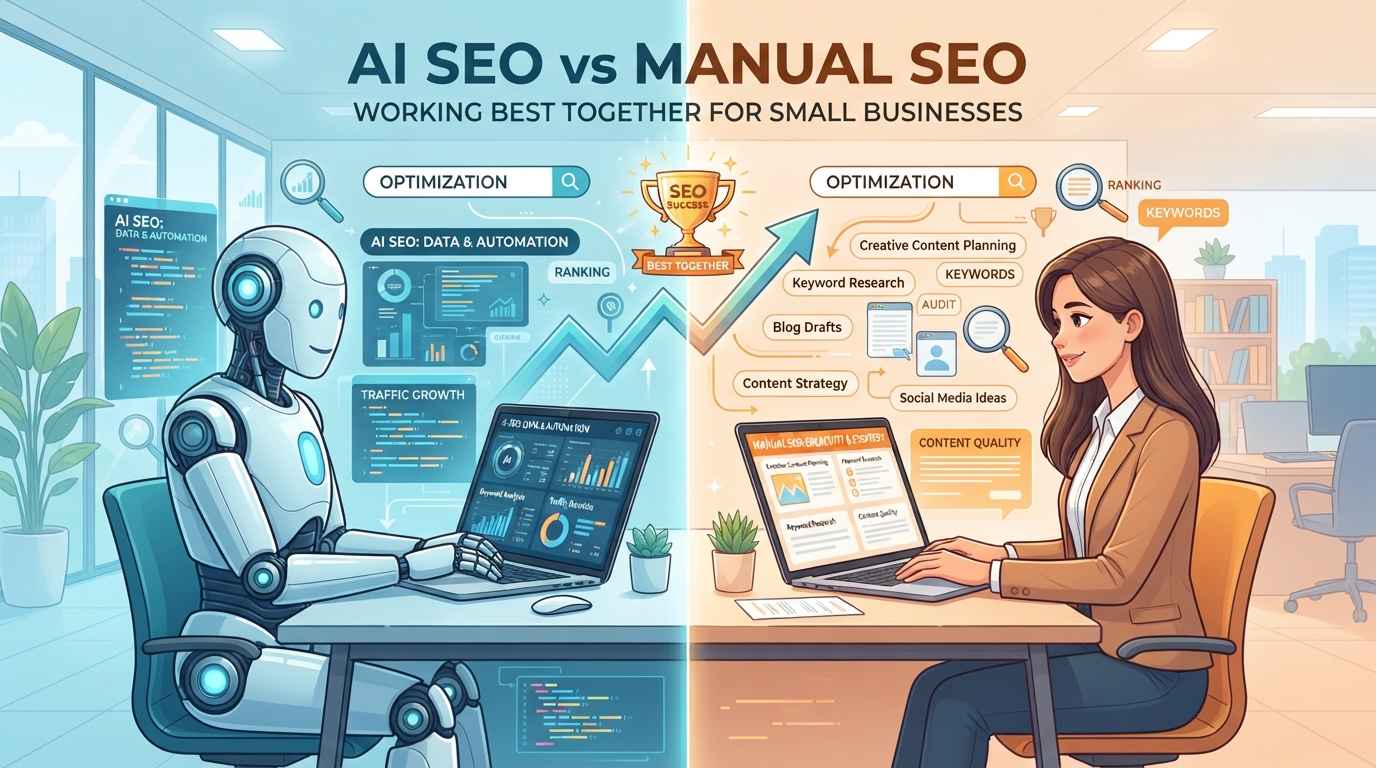
The debate between AI SEO and manual SEO has become one of the most important decisions small business owners face in 2026. On one side, AI SEO tools promise to automate keyword research, content optimization, and rank tracking at a fraction of the cost of hiring help. On the other side, manual SEO—whether done yourself or through an agency—offers human judgment, strategic thinking, and creative content that AI still can’t fully replicate.
So which approach actually delivers better results for your small business? The honest answer: neither approach alone is best for most businesses. The most successful small businesses in 2026 use a hybrid model—leveraging AI SEO tools for efficiency and data analysis while relying on human expertise for strategy, creativity, and quality control.
In this AI SEO vs manual SEO comparison, we’ll break down exactly what each approach can and cannot do, what they cost in real numbers, and how to build a strategy that combines the strengths of both. If you haven’t already explored the available tools, our guide to the best AI SEO tools for small businesses covers the top options for every budget.
Table of Contents
- What AI SEO Can Do (and Cannot Do) in 2026
- What Manual SEO Provides That AI Cannot
- AI SEO vs Manual SEO: Complete Cost Comparison
- Time Investment: AI SEO vs Manual SEO
- Quality and Risk: Where Each Approach Wins
- Best Scenarios for AI-Only SEO
- Best Scenarios for Manual or Agency SEO
- The Hybrid Model: How to Combine AI SEO and Manual SEO
- AI SEO vs Manual SEO: Decision Framework
- Common Mistakes When Choosing Between AI and Manual SEO
- Final Verdict: AI SEO vs Manual SEO for Your Business
What AI SEO Can Do (and Cannot Do) in 2026
When people talk about AI SEO vs manual SEO, they’re usually comparing AI-powered software tools against human effort. AI SEO tools in 2026 are genuinely impressive—but they have clear limitations that every small business owner should understand before investing.
What AI SEO Tools Do Well
Keyword research at scale. AI SEO tools can analyze thousands of keywords in seconds, providing search volume estimates, difficulty scores, and competitive analysis that would take a human days to compile manually. Tools like Mangools and SE Ranking have made professional-grade keyword research accessible even on small budgets. See our complete AI SEO tools comparison for specific recommendations.
Content optimization against live SERP data. This is where AI SEO truly shines in the AI SEO vs manual SEO comparison. Tools like Surfer SEO and Frase analyze the top-ranking pages for any keyword and tell you exactly which topics, terms, and structures you need to include. A human can guess what Google wants—AI can measure it against real data from 50 top-ranking pages simultaneously.
Technical SEO auditing. AI-powered site audits can crawl your entire website in minutes, identifying broken links, missing meta tags, slow-loading pages, mobile usability issues, and dozens of other technical problems. The AI then prioritizes these issues by potential impact, giving you a clear action plan. Manual technical audits for the same site would take hours or days.
Rank tracking and competitor monitoring. AI tools track your keyword rankings daily and alert you when competitors make significant changes. They can spot patterns—like a competitor suddenly publishing 20 new pages targeting your keywords—that a human would likely miss until traffic starts dropping.
Content briefs and outlines. AI SEO tools can generate detailed content briefs in minutes, showing you exactly what topics, headings, questions, and keywords top-ranking pages cover. This transforms content planning from guesswork into data-driven strategy.
What AI SEO Tools Cannot Do
Critical limitation: AI cannot understand your specific customers, your industry nuances, or your unique business value. It analyzes patterns in data—it doesn’t have real experience serving your customers.
AI cannot write genuinely original thought leadership. AI content generation tools can produce grammatically correct articles that cover standard topics. But they cannot share real experiences, unique insights from years in your industry, or original opinions based on actual customer interactions. When the AI SEO vs manual SEO debate focuses on content quality, manual still wins for originality and authenticity.
AI cannot build real relationships for link building. Getting other websites to link to yours—one of the most powerful ranking factors—requires outreach, relationship building, and providing genuine value to other site owners. AI can help identify link opportunities, but it cannot write personalized outreach emails that actually get responses or build the relationships that lead to natural backlinks.
AI cannot guarantee factual accuracy. AI SEO tools can hallucinate—generating plausible-sounding but completely false information. This is especially dangerous in YMYL (Your Money or Your Life) industries like healthcare, finance, and legal services. Every AI-generated claim must be fact-checked by a knowledgeable human before publication. Our guide to common SEO mistakes covers this risk in detail.
AI cannot make strategic business decisions. AI can tell you which keywords have high search volume and low competition. But it cannot tell you which keywords represent your ideal customers, which topics align with your business goals, or whether investing in SEO is the right move for your business right now. Those decisions require human judgment.
What Manual SEO Provides That AI Cannot
In the AI SEO vs manual SEO debate, manual SEO—whether done by you or a hired professional—brings capabilities that remain exclusively human in 2026.
Strategic Thinking and Business Context
A human SEO strategist understands that ranking for “cheap divorce lawyer” might bring traffic but attract the wrong clients for a premium family law practice. They know your business goals, your ideal customer profile, and your competitive landscape in ways that AI simply cannot. This strategic layer is where manual SEO provides the most value in the AI SEO vs manual SEO equation.
Creative Content That Demonstrates Real Experience
Google’s 2026 algorithm places enormous weight on demonstrated experience. When a restaurant owner writes about their kitchen operations, a plumber explains why certain pipes fail in local soil conditions, or a financial advisor shares real client scenarios (anonymized), that content carries authenticity signals that AI-generated content cannot replicate. Our small business SEO guide emphasizes this principle throughout.
Brand Voice and Customer Understanding
Your customers choose you partly because of who you are—your personality, your approach, your values. AI can mimic a generic brand voice, but it cannot authentically capture the specific tone that makes your business unique. When customers read your content, they should feel like they’re hearing from you, not from a content mill.
Quality Control and Editorial Judgment
A skilled human editor knows when a piece of content is genuinely helpful versus when it’s just checking boxes on an SEO checklist. They can identify sections that need more detail, examples that don’t resonate, or claims that need better evidence. AI content scoring tools provide useful guidance, but they cannot replace human editorial judgment.
AI SEO vs Manual SEO: Complete Cost Comparison
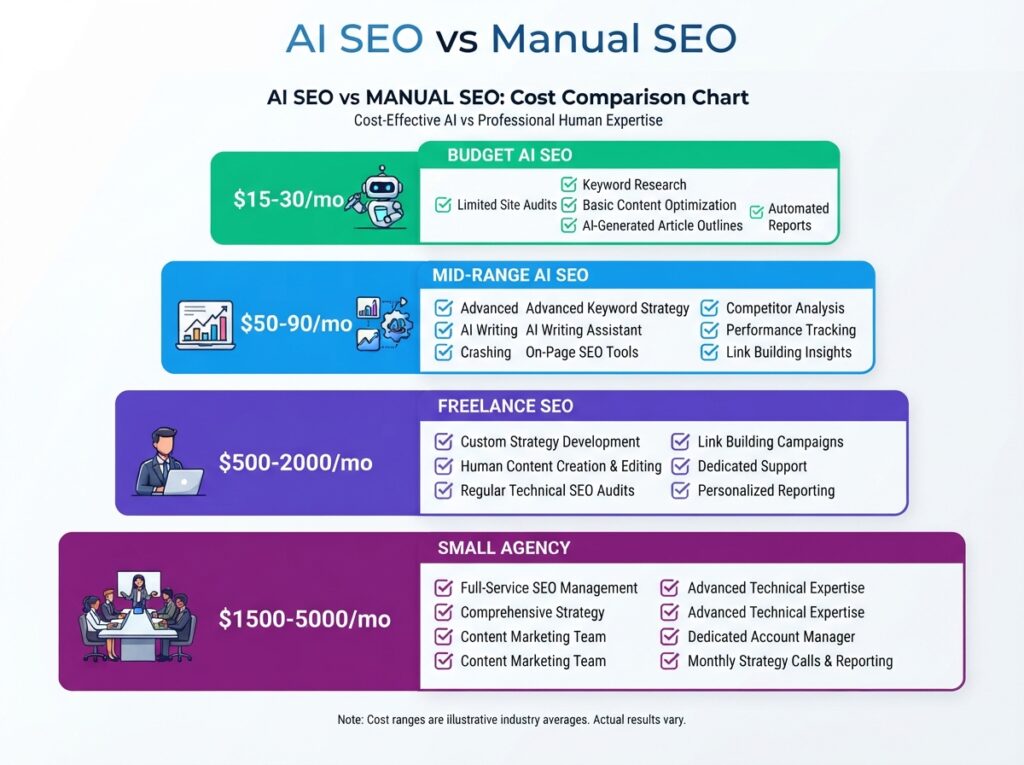
Let’s put real numbers behind the AI SEO vs manual SEO cost debate. Here’s what each approach actually costs for a typical small business in 2026:
AI SEO Tool Costs
| Tool Tier | Monthly Cost | What You Get | Best For |
|---|---|---|---|
| Budget AI SEO | $15–$30/month | Content optimization + basic keyword research (Frase + Mangools) | Solopreneurs starting out |
| Mid-Range AI SEO | $50–$90/month | Full suite: keyword research, content optimization, rank tracking, site audits (SE Ranking or Surfer SEO) | Growing small businesses |
| Premium AI SEO | $130–$300/month | Enterprise-grade tools with largest databases, AI content generation, competitive intelligence (Semrush or Ahrefs) | Established businesses with dedicated marketing |
Manual SEO Costs
| Option | Monthly Cost | What You Get | Best For |
|---|---|---|---|
| DIY Manual SEO | $0 (just your time) | Full control, steep learning curve, 10–20 hours/week needed | Owners with time and interest in learning SEO |
| Freelance SEO Specialist | $500–$2,000/month | Part-time help, 10–20 hours/month, varying quality | Businesses needing strategy + implementation help |
| Small SEO Agency | $1,500–$5,000/month | Full-service: strategy, content, technical, link building | Businesses where SEO is a primary growth channel |
| Premium SEO Agency | $5,000–$15,000+/month | Enterprise-level service with dedicated team | Competitive industries, large websites |
The Hybrid Cost Sweet Spot
Our recommendation for most small businesses: Invest $55–$150/month in AI SEO tools for data, research, and optimization efficiency, plus either 5–10 hours/week of your own time (DIY) or $500–$1,500/month for a freelance specialist who provides strategy and handles complex tasks. Total monthly investment: $55–$1,650 depending on your approach. This hybrid model consistently delivers the best ROI in real-world AI SEO vs manual SEO comparisons.
Not sure what budget makes sense for your business? Our SEO budget planning guide helps you calculate the right investment based on your revenue, competition, and growth goals.
Time Investment: AI SEO vs Manual SEO
Time is often the scarcest resource for small business owners. Here’s how AI SEO vs manual SEO compare in terms of time requirements:
Time Required for Common SEO Tasks
| SEO Task | Manual Time | AI-Assisted Time | Time Saved |
|---|---|---|---|
| Keyword research (10 keywords) | 3–4 hours | 30–45 minutes | 80% |
| Content brief creation | 45–60 minutes | 5–10 minutes | 85% |
| On-page optimization (1 page) | 1–2 hours | 20–30 minutes | 70% |
| Technical site audit | 4–8 hours | 5–10 minutes | 95% |
| Competitor analysis | 3–5 hours | 15–30 minutes | 90% |
| Rank tracking (50 keywords) | 1–2 hours | Automated | 100% |
| Content writing (2,000 words) | 4–6 hours | 2–3 hours (AI-assisted) | 40–50% |
The time savings from AI SEO tools are dramatic for research and analysis tasks—often 80–95% faster than manual methods. Content creation sees more modest time savings (40–50%) because quality content still requires significant human input even with AI assistance. This is a key insight in the AI SEO vs manual SEO comparison: AI excels at data processing, but content creation remains substantially human work.
Quality and Risk: Where Each Approach Wins
The AI SEO vs manual SEO debate isn’t just about cost and time—it’s also about quality and risk management.
Where AI SEO Quality Excels
- Data accuracy: AI tools process vast datasets without human error or fatigue
- Consistency: AI applies the same optimization standards across every page, every time
- Comprehensiveness: AI catches technical issues and content gaps a human might miss
- Speed of analysis: AI identifies patterns and opportunities faster than any human can
Where Manual SEO Quality Excels
- Originality: Humans create genuinely unique insights, stories, and perspectives
- Accuracy: Humans verify facts and understand context that AI misses
- Emotional connection: Humans write content that resonates on a personal level
- Strategic judgment: Humans know when to follow SEO best practices and when to break them
Risk Comparison: AI SEO vs Manual SEO
Biggest AI SEO risk: Publishing AI-generated content without human review. Google’s guidelines on AI-generated content are clear—content must be helpful, accurate, and created for people. Mass-produced AI content can trigger manual actions and ranking penalties.
Biggest manual SEO risk: Incomplete optimization. A human working without AI tools will inevitably miss technical issues, content gaps, and competitor movements that AI would catch instantly. Manual SEO without data support is essentially guessing.
The hybrid solution to both risks: Use AI SEO tools for comprehensive analysis, data processing, and optimization suggestions. Use human judgment for content creation, strategy, and final quality review. This approach minimizes the risks of both pure AI and pure manual approaches.
Best Scenarios for AI-Only SEO
While we recommend a hybrid approach for most businesses, there are specific scenarios where an AI-only SEO strategy can work effectively:
Very small websites (under 20 pages). If your business has a simple brochure-style website with basic service pages and a blog you update monthly, AI SEO tools alone can handle keyword research, on-page optimization, and basic rank tracking. Tools like Rank Math for WordPress users provide AI-powered SEO guidance directly in your editor for just $6.99/month.
Low-competition niches. If you operate in a niche where competitors aren’t doing sophisticated SEO—common in local service businesses in smaller towns—AI tools can give you a significant advantage without requiring manual expertise. Our local SEO guide covers strategies specifically for these scenarios.
Budget-constrained startups. When you genuinely cannot afford even a freelance SEO specialist, AI SEO tools provide professional-grade optimization at a fraction of the cost. A $30/month AI SEO stack used consistently will outperform doing nothing or doing SEO without data.
SEO is a secondary channel. If your business primarily grows through referrals, paid ads, or social media, and SEO is just a supplementary channel, AI tools can maintain basic optimization without requiring significant time or budget investment.
Best Scenarios for Manual or Agency SEO
On the other side of the AI SEO vs manual SEO equation, some situations genuinely require human expertise:
Highly competitive industries. If you’re competing against well-funded national brands with dedicated SEO teams, AI tools alone won’t be enough. You need human strategists who can find creative angles, build genuine backlink relationships, and create content that stands out in crowded search results.
YMYL (Your Money or Your Life) industries. Healthcare, finance, legal services, and insurance face the highest standards for content quality and accuracy. In these industries, AI-generated content that hasn’t been thoroughly reviewed by qualified professionals can actually harm your business. Google holds YMYL sites to much higher E-E-A-T (Experience, Expertise, Authoritativeness, Trustworthiness) standards.
Complex websites with technical issues. If your website has hundreds of pages, multiple content types, e-commerce functionality, or custom development, you likely need a professional who can diagnose and fix technical SEO issues that AI audit tools identify but cannot resolve.
Brand building through thought leadership. If your SEO strategy relies on establishing yourself or your business as an industry authority, AI cannot create the original research, unique frameworks, or personal insights that build genuine thought leadership. This type of content requires human expertise.
The Hybrid Model: How to Combine AI SEO and Manual SEO
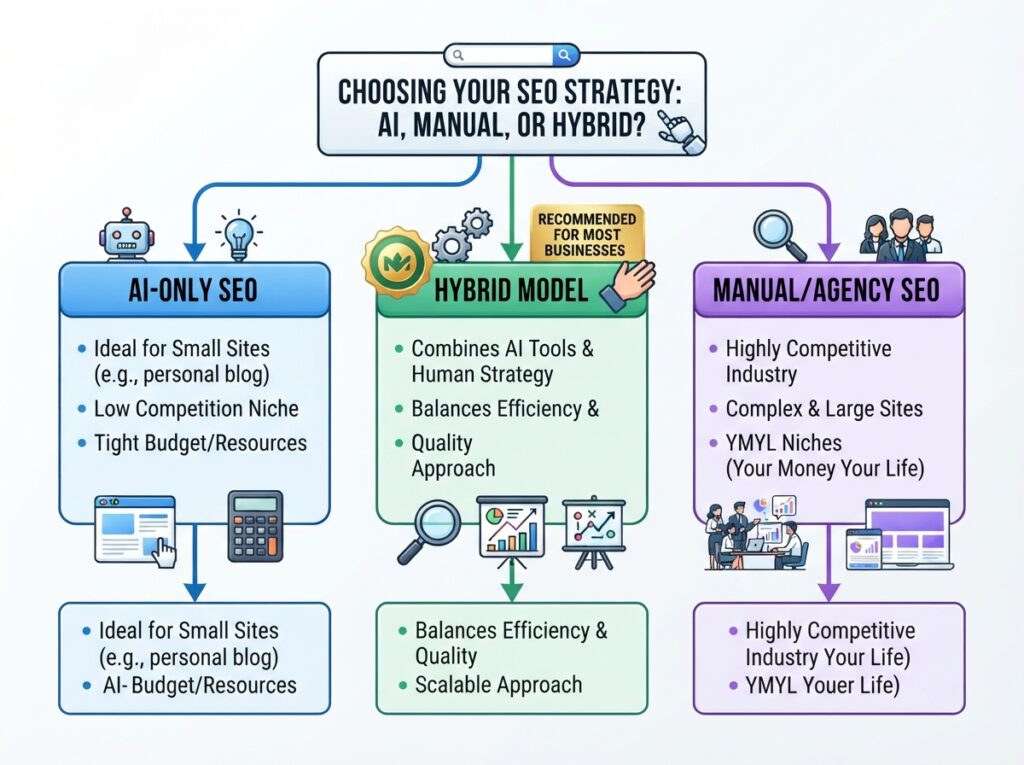
The most successful small businesses we’ve observed don’t choose between AI SEO vs manual SEO—they combine both strategically. Here’s exactly how the hybrid model works in practice:
The Hybrid Workflow
Step 1: AI-powered research (30–60 minutes/week). Use AI SEO tools to identify keyword opportunities, analyze competitor strategies, and audit your site for technical issues. Tools like SE Ranking and Semrush handle this phase. For specific tool recommendations, see our AI SEO tools comparison guide.
Step 2: Human strategy (1–2 hours/week). Review the AI-generated data and make strategic decisions. Which keywords align with your business goals? Which content topics will resonate with your specific customers? What’s the priority order for fixing technical issues? AI provides the data—you provide the judgment.
Step 3: AI-assisted content creation (2–4 hours per piece). Use AI tools like Frase or Surfer SEO to generate content briefs and outlines based on competitive analysis. Let the AI tell you what topics and terms to cover. Then write the content yourself or with a human writer, using the AI outline as a guide but adding your own expertise, examples, and voice. Our guide to AI content writing for SEO explains this process in detail.
Step 4: Human review and optimization (30–60 minutes per piece). Before publishing, have a knowledgeable human review every piece of content for accuracy, brand voice, and genuine helpfulness. Use AI scoring tools to verify optimization, but never let the AI score override human editorial judgment.
Step 5: AI-powered monitoring (automated). Let AI tools track your rankings, monitor competitor changes, and alert you to technical issues. Review the data weekly or monthly, but let the AI handle the 24/7 monitoring that no human can reasonably do.
What the Hybrid Model Costs
For most small businesses, the hybrid model costs $55–$150/month in AI SEO tools plus either your own time (5–10 hours/week) or $500–$1,500/month for a freelance specialist. This is dramatically less than a full-service agency ($1,500–$5,000/month) while delivering significantly better results than AI tools alone.
AI SEO vs Manual SEO: Decision Framework
Choose AI-Only SEO If:
- Your website has fewer than 20 pages
- You’re in a low-competition niche or small local market
- Your budget is under $100/month total for SEO
- SEO is a secondary marketing channel for your business
- You’re comfortable using software tools and learning basic SEO concepts
Choose Manual or Agency SEO If:
- You’re in a highly competitive industry with sophisticated competitors
- Your business is in a YMYL category (health, finance, legal, insurance)
- Your website has 100+ pages with complex technical requirements
- Your strategy depends on thought leadership and original research
- You have zero time for marketing tasks and need full-service support
Choose the Hybrid Model If:
- You want the best results for a reasonable budget (applies to most small businesses)
- You have 5–10 hours/week for SEO but want AI to handle data and analysis
- You value both efficiency and quality
- You want to maintain control over your content and strategy
- You’re willing to invest $55–$150/month in tools plus either time or freelance help
Common Mistakes When Choosing Between AI and Manual SEO
Mistake 1: Assuming AI can replace all human SEO work. This is the most expensive mistake in the AI SEO vs manual SEO debate. Businesses that replace their entire SEO process with AI tools typically see initial efficiency gains followed by ranking declines as Google identifies and devalues their AI-generated, non-original content. Learn more about avoiding this in our guide to common SEO mistakes.
Mistake 2: Ignoring AI tools entirely because you prefer the “human touch.” Refusing to use AI SEO tools in 2026 is like refusing to use email in 2005. Your competitors are using AI for research and analysis—if you’re not, you’re operating with less data and lower efficiency than everyone else in your market.
Mistake 3: Spending too much on either approach. Some businesses buy expensive enterprise AI tools they barely use. Others hire expensive agencies for tasks AI could handle for $30/month. Match your spending to your actual needs and usage patterns.
Mistake 4: Not fact-checking AI-generated content. Every AI SEO tool can produce incorrect information. Publishing AI content without human review is the fastest way to damage your site’s credibility and rankings.
Mistake 5: Choosing before understanding your needs. The AI SEO vs manual SEO decision should follow your business analysis, not precede it. First, understand your market, your competition, your resources, and your goals. Then choose the approach that matches your specific situation.
Final Verdict: AI SEO vs Manual SEO for Your Business
After comparing AI SEO vs manual SEO across cost, time, quality, and risk, here’s our straightforward recommendation for small businesses in 2026:
Start with AI SEO tools. For $15–$55/month, you get professional-grade keyword research, content optimization, and technical auditing. Set up Google Search Console and Google Analytics (both free). Learn the fundamentals with our small business SEO guide.
Add human expertise where it matters most. For content creation, strategic decisions, and quality control, invest either your own time or hire freelance help. AI tools handle the data—humans handle the judgment.
Scale based on results. If SEO starts generating meaningful revenue, reinvest some of that revenue into better tools or more human expertise. If you’re seeing diminishing returns, reassess whether you need more AI efficiency or more human creativity.
The businesses winning at SEO in 2026 aren’t choosing between AI and humans—they’re combining the strengths of both. AI provides speed, scale, and data-driven insights. Humans provide strategy, creativity, authenticity, and judgment. Together, they deliver results that neither can achieve alone.
Ready to build your SEO strategy? Explore the best AI SEO tools for small businesses to find the right software for your needs. Learn the fundamentals with our complete small business SEO guide. And if you need to plan your investment, our SEO budget planning guide will help you determine the right spend for your business stage.
